Precision-formulated reagents, high-purity etching media, and advanced synthetic polymers tailored for international semiconductor fabs and metallurgical manufacturers.





Unpacking the fundamental chemistry of Tetrafluoromethane (CAS: 75-73-0, UN: 1982) and its indispensable role in state-of-the-art anisotropic dry etching.
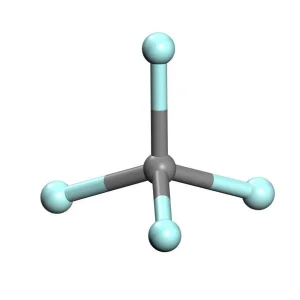
Carbon Tetrafluoride (Formula: CF₄), systematically known as tetrafluoromethane, stands as the most stable perfluorocarbon compound in industrial chemistry. Characterized by a tetrahedral sp³-hybridized geometry with four fluorine atoms symmetrically bound to a central carbon atom, CF₄ exhibits an exceptionally high carbon-fluorine bond dissociation energy of approximately 515 kJ/mol. This structural thermodynamic stability ensures non-flammability, chemical inertness under atmospheric ambient conditions, and extreme dielectric strength. However, when accelerated within a high-density inductively coupled plasma (ICP) or capacitively coupled plasma (CCP) chamber, the compound dissociates cleanly into reactive fluorine radicals (F·) and fluorocarbon cations (CF₃⁺), forming the critical backbone for ultra-fine anisotropic micro-machining of silicon-based thin films.
In modern sub-10nm logic chip nodes and 3D NAND flash memory fabrication, achieving uniform material removal across 300mm silicon wafers requires sub-ppm impurity controls. Extraneous moisture, oxygen traces, or hydrocarbons generate unwanted polymer deposits or parasitic chemical attacks, leading to micromasking and fatal line-edge roughness. Yanxatech System Industries Limited (YANXA) implements continuous catalytic fluorination, cryogenic dual-column fractional distillation, and point-of-fill gas chromatography to offer grade-specific CF₄ solutions up to 99.999% (5N) and 99.9995% (5.5N) purity levels.
| Critical Parameter | Industrial Reagent Grade | Electronic Grade (VLSI) | Ultra-Pure Node Grade (ULSI - 5.5N) |
|---|---|---|---|
| CF₄ Chemical Assay | ≥ 99.9% | ≥ 99.999% (5N) | ≥ 99.9995% (5.5N) |
| Moisture (H₂O) Content | < 15.0 ppmv | < 1.0 ppmv | < 0.2 ppmv |
| Oxygen + Argon (O₂ + Ar) | < 40.0 ppmv | < 2.0 ppmv | < 0.5 ppmv |
| Nitrogen (N₂) Limit | < 60.0 ppmv | < 4.0 ppmv | < 1.0 ppmv |
| Carbon Monoxide & Dioxide (CO+CO₂) | < 10.0 ppmv | < 1.0 ppmv | < 0.2 ppmv |
| Acidity (as HF) | < 1.0 ppmw | < 0.1 ppmw | < 0.05 ppmw |
Strategic market drivers, geopolitical supply diversification, and rigorous multi-sourcing dynamics reshaping global CF₄ procurement frameworks.
The rapid proliferation of artificial intelligence compute clusters requires dense multi-layer 3D stacking (such as HBM3e/HBM4). These architectures dramatically multiply the cumulative depth of silicon oxide and silicon nitride plasma etching cycles, propelling global electronic CF₄ demand at double-digit CAGR.
Semiconductor foundries across North America, Europe, and East Asia are aggressively de-risking raw material supply chains. Corporate tier-one procurement protocols mandate certified direct factory partners possessing vertically integrated upstream fluorspar (CaF₂) access and stable export channels.
CF₄ carries a high Global Warming Potential (GWP₁₀₀ ~ 7,380). International fab operators prioritize chemical factories that engineer high-efficiency, low-waste synthesis pathways, coupled with high-yield thermal and plasma point-of-use scrubbers to minimize total lifecycle emissions.
How automated closed-loop distillation, deep fluorite raw material integration, and rigorous cylinder passivation deliver unbeatable cost efficiencies.
Direct reaction of fluorine gas (F₂) with high-grade carbonaceous precursors under computerized Distributed Control Systems (DCS). Automated multi-stage temperature control prevents thermal runaway and curtails the generation of higher perfluorocarbon byproducts (C₂F₆, C₃F₈).
China holds world-class fluorite deposits, giving domestic production hubs unprecedented access to hydrofluoric acid (HF) precursors. This upstream vertical linkage insulates international buyers from intermediate supply crunches, delivering consistent and predictable factory quotes.
Cylinder integrity dictates delivered gas quality. Our automated cylinder lines execute ultrasonic internal solvent washing, high-temperature vacuum baking (> 180°C), and ultra-pure helium mass spectrometer leak inspections, followed by strict surface passivation.
Customized gas blends and tailored cylinder packages engineered to match diverse production parameters across global manufacturing clusters.
Applied extensively in the dry etching of silicon dioxide (SiO₂), silicon nitride (Si₃N₄), and titanium silicide layers. When blended with oxygen (O₂) or hydrogen (H₂), CF₄ plasma modulates etching selectivity ratios, creating razor-sharp vertical sidewall profiles.
Utilized across Gen 8.5 to Gen 10.5 display manufacturing lines for chemical vapor deposition (CVD) chamber cleaning. CF₄ dislodges amorphous silicon and oxide coatings from internal surfaces, minimizing line maintenance downtime.
Because of its low boiling point (-128.1°C) and robust thermodynamic chemical stability, CF₄ functions as an active refrigerant component (R-14) in cascade refrigeration systems targeting deep cryogenic environments (-100°C to -150°C).
Clear, authoritative answers addressing compliance, packaging options, dangerous cargo documentation, and batch quality guarantees.
The exact chemical formula is CF₄ (CAS Registry Number: 75-73-0, EC Number: 200-896-5). It holds a molecular weight of 88.004 g/mol, a melting point of -183.6°C, and a boiling point of -128.1°C at atmospheric pressure.
Every export shipment includes a lot-specific Certificate of Analysis (COA) tested via Gas Chromatography with Discharge Ionization Detectors (GC-DID), a multi-language 16-section GHS Safety Data Sheet (SDS), Technical Data Sheets (TDS), packing declarations, and commercial export certifications.
Under UN Model Regulations and IMDG / IATA codes, Carbon Tetrafluoride is classified as Class 2.2: Non-Flammable, Non-Toxic Gas (UN Number: 1982, Proper Shipping Name: CARBON TETRAFLUORIDE or REFRIGERANT GAS R 14).
We provide seamless steel cylinders meeting ISO 9809, DOT-3AA, and TPED standards across 10L, 40L, 47L, and 50L volumes. Standard valve configurations include CGA 580, CGA 320, DISS 638, or DIN 477 No. 6, configured to client line hookups.
Our processing plant deploys deep cryogenic molecular sieve scrubbers followed by cryogenic fractional distillation columns operating under positive pressures. Point-of-fill lines undergo automated continuous moisture and oxygen sensor checks down to the sub-ppm threshold.
Yes. We regularly facilitate SGS, TÜV, or Bureau Veritas batch sampling, volume verification, and cylinder pressure testing at our loading docks prior to ocean freight vessel departure.
Browse our certified high-performance synthetic polymers, noble gases, pure metallic flakes, and precision acetate salts ready for export dispatch.